Skip to content

Category: english

Simple Java Tileset Example

Tilesets are a common technique in game development to create all kinds of tile-based games (from strategy to RPG games).

Here’s a example of simple 2D isometric square tilesets. I decided to use 32×32 pixels tiles and store 10 tiles per row in a single image:

I created a class called public class JGameCanvas that extends from JPanel from swing:

package game;

import java.awt.Color;
import java.awt.Graphics;
import java.awt.Image;
import java.awt.Toolkit;
import javax.swing.JPanel;

enum Tile {
GRASS, GRASS_STONE, GRASS_BAGS, T3, T4, T5, T6, T7, T8, T9,
TREE, TREE_CHOMP, TREE_DEAD, T13, T14, T15, T16, T17, T18, T19,
ROAD_H, ROAD_V, ROAD_HV_DOWN, ROAD_HV_UP, ROAD_VH_RIGHT, ROAD_VH_LEFT, ROAD_CROSS, T27, T28, T29,
WALL, WALL_POSTER, WALL_END_RIGHT, WALL_END_LEFT, T34, T35, T36, T37, T38, T39,
T40, T41, T42, T43, T44, T45, T46, T47, T48, T49,
NEWS, T51,      RES_1, RES_2, BUSS_1, BUSS_2, HOSP_1, HOSP_2, MARK_1, MARK_2,
PIZZ_1, PIZZ_2, RES_3, RES_4, BUSS_3, BUSS_4, HOSP_3, HOSP_4, MARK_3, MARK_4,
PIZZ_3, PIZZ_4, RES_5, RES_6, BUSS_5, BUSS_6, HOSP_5, HOSP_6, MARK_5, MARK_6
}

public class JGameCanvas extends JPanel{
    private static final int tW = 32; // tile width
    private static final int tH = 32; // tile height
    private static final Tile map[][] =
    {{Tile.TREE,Tile.TREE, Tile.TREE, Tile.ROAD_V, Tile.GRASS, Tile.TREE, Tile.TREE_DEAD, Tile.GRASS_STONE, Tile.TREE, Tile.TREE},
     {Tile.WALL, Tile.WALL_POSTER, Tile.WALL_END_RIGHT , Tile.ROAD_V, Tile.WALL_END_LEFT, Tile.WALL, Tile.WALL_END_RIGHT, Tile.TREE_CHOMP, Tile.GRASS_STONE, Tile.GRASS_STONE},
     {Tile.GRASS,Tile.GRASS, Tile.GRASS_STONE, Tile.ROAD_V, Tile.GRASS, Tile.GRASS, Tile.GRASS, Tile.GRASS, Tile.GRASS, Tile.GRASS},
     {Tile.PIZZ_1,Tile.PIZZ_2, Tile.GRASS, Tile.ROAD_V, Tile.GRASS, Tile.GRASS, Tile.GRASS, Tile.GRASS, Tile.GRASS, Tile.GRASS},
     {Tile.PIZZ_3,Tile.PIZZ_4, Tile.GRASS, Tile.ROAD_V, Tile.GRASS, Tile.GRASS, Tile.MARK_1, Tile.MARK_2, Tile.HOSP_1, Tile.HOSP_2},
     {Tile.ROAD_H,Tile.ROAD_H, Tile.ROAD_H, Tile.ROAD_VH_LEFT, Tile.TREE, Tile.TREE_DEAD, Tile.MARK_3, Tile.MARK_4, Tile.HOSP_3, Tile.HOSP_4},
     {Tile.GRASS,Tile.BUSS_1, Tile.BUSS_2, Tile.ROAD_V, Tile.TREE, Tile.NEWS, Tile.MARK_5, Tile.MARK_6, Tile.HOSP_5, Tile.HOSP_6},
     {Tile.GRASS,Tile.BUSS_3, Tile.BUSS_4, Tile.ROAD_VH_RIGHT, Tile.ROAD_H, Tile.ROAD_H, Tile.ROAD_H, Tile.ROAD_H, Tile.ROAD_H, Tile.ROAD_H},
     {Tile.GRASS,Tile.BUSS_5, Tile.BUSS_6, Tile.ROAD_V, Tile.GRASS, Tile.GRASS, Tile.GRASS, Tile.GRASS, Tile.GRASS, Tile.GRASS},
     {Tile.GRASS,Tile.GRASS, Tile.GRASS, Tile.ROAD_V, Tile.GRASS, Tile.GRASS, Tile.GRASS, Tile.GRASS, Tile.GRASS, Tile.GRASS}
    };

    private Image tileset;

    public JGameCanvas() {
        tileset = Toolkit.getDefaultToolkit().getImage(this.getClass().getResource("resources/tileset.png"));
    }

    @Override
    protected void paintComponent(Graphics g) {
        g.setColor(Color.black);
        g.fillRect(0, 0, getWidth(), getHeight());

        for(int i=0;i<10;i++)
            for(int j=0;j<10;j++)
                drawTile(g, map[j][i], i*tW,j*tH);
    }

    protected void drawTile(Graphics g, Tile t, int x, int y){
        // map Tile from the tileset
        int mx = t.ordinal()%10;
        int my = t.ordinal()/10;
        g.drawImage(tileset, x, y, x+tW, y+tH,
                mx*tW, my*tH,  mx*tW+tW, my*tH+tH, this);
    }
}

Program running:

Those graphics I created for the game Batalhão and are under Creative Commons Attribution Share Alike 3.0 license. The source code is under GPL license, download the NetBeans project with sources: tileset.tar.bz2.

NetBeans Day Fortaleza with Gregg Sporar

Gregg Sporar and CEJUG

Those days Gregg Sporar, NetBeans enthusiast working at Sun Microsystems was here in Brazil and went to our city Fortaleza to speak in our NetBeans Day Fortaleza. We had only a couple of days to prepare everything but is always good work under such pressure. 🙂

Me at the airport

Me and my friend (Cassiano Carvalho) could toke care of him. First we got Gregg at our international airport, Pinto Martins from a flight from Recife. After that we went to a typical food dinner at Coco Bambu where’s Gregg could taste our tapioca and figure why our local JUG (CEJUG) event is called Tapioca with Coffee.

Gregg tasting Tapioca

After that we went to the hotel but we did not have realized that that day was the birthday of our city Fortaleza and the birthday party was a public concert at beach of one of most famous artist in Brazil, Roberto Carlos.

Roberto Carlos in the early years
Roberto Carlos in the early years… 😛

For those who are not Brazilians, To have an idea what Roberto Carlos is, just imagine (in a smaller proportion of course) some kind of Brazilian Elvis Presley. When we quited the restaurant the show was just finished, we had a huge crowd walking back for everywhere, streets blocked, mess and traffic extremely slow. We spend about two hour on this. We decided to park the car, get Gregg’s luggage and go walking the hotel. Luckily the rain don’t caught us.

Rainy Day

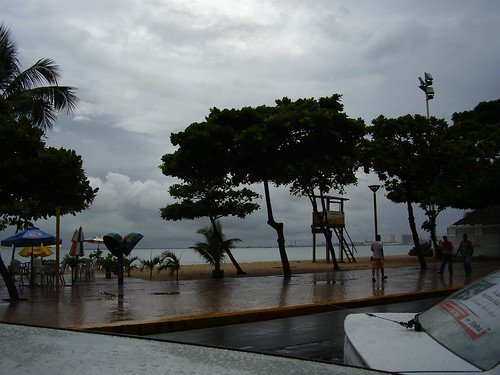
In the morning was raining cats and dogs at Fortaleza, what is very uncommon.

Gregg cheking out

I picked Gregg at the hotel to the campus so we can meet the NPD (acronym in Portuguese for Data Processing Core) building, the Internet backbone of the entire state and where some projects are using NetBeans. Gregg also met our CS department, our labs and our cluster.

While that we prepared the auditorium and some last details, test microphones and projector.

P4140007 P4140006

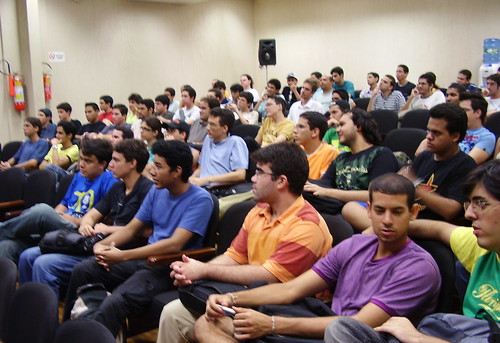
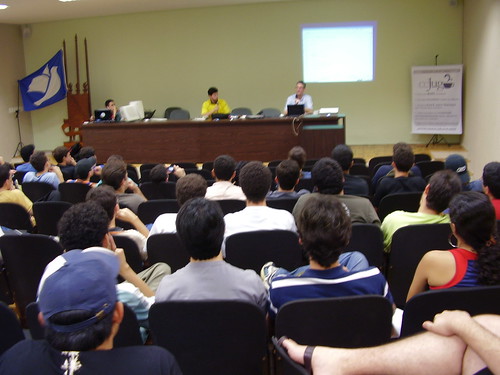
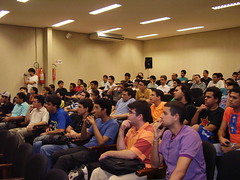
People started to get and we got their names and mails for event certifications. I opened the event talking about NetBeans, CEJUG projects and opportunities for the students.

P4140019

P4140024

People from TV Software Livre (Free Software Television) was there too to record and transmit the event.

P4140017 P4140025

The first Gregg’s talk was about NetBeans and some new features from the last version of NetBeans and some new features for the version 6.1.

P4140045

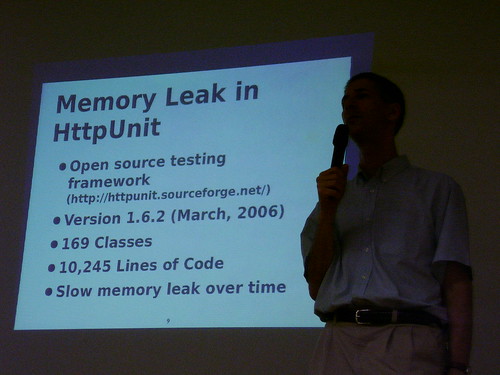
The second was about Memory Leaks in Java and a method for detecting those. Very interesting.

Gregg Sporar

NetBeans Day Fortaleza

NetBeans Day Fortaleza

NetBeans Day NetBeans Day Fortaleza

Gregg Sporar

After Gregg quited to fly to Brasilia I did a presentation on NetBeans 6 and 6.1 Beta news features. You can download Gregg’s slides here and here, my slides here.The recorded video is hosted at Google Video. You can see more photos in this album:

Gregg Sporar

Gregg, thank you very much and hope you liked your quick visit to Fortaleza. 😉 Thanks also CEJUG and all guys that made this event possible.

Integer.MAX_VALUE and Integer.MIN_VALUE

You should know that variable values are cyclic in Java.

public class Test{
  public static void main(String args[]){
     System.out.println(Integer.MAX_VALUE);
     System.out.println(Integer.MIN_VALUE);
     int x = Integer.MAX_VALUE + 1;
     System.out.println(x);
  }
}

This produces:

2147483647
-2147483648
-2147483648

Second certification meeting

Students holding Netbeans CDs

We are meeting every Thursday to talk about Java and certifications (and sometimes about local projects at an operational level). In this moment we are talking about the firsts sections of SCJA and solving mock exams in group.

Our approach is, each week a certification topic, each topic and different person talking. Meetings are free and anyone can join. I’m trying to keep those meeting linked with CEJUG and take we all to the monthly CEJUG meetings.

JEG second meeting

So next Thursday I’ll not talk. Those slides I used aren’t finished yet so I’ll not share them now, but as soon as possible I’ll do that. More photos here.

OpenSolaris SVG Poster

Sometimes we just need an good template for organizing a OpenSolaris event, I didn’t found a good one in a reusable format so I did this empty OpenSolaris SVG Poster.

OpenSolaris SVG Poster
Download the svg file: opensolaris_poster.svg

But why an SVG poster? SVG means Scalable Vector Graphics, an XML specification and file format for describing two-dimensional vector graphics. If you use a typical bitmap format like png, gif or jpg and need to scale the image you will loss image quality.

Example of loss of image quality in a bitmap format

Using a vector graphics format you can scaled the image indefinitely without loss of image quality.

Example of loseless quality in svg image

Additionally is a free and open format and also very reusable. You can edit and use it in a broad set of tools, from a scalable image editor like Inkscape to, believe it or not, Netbeans!

OpenSolaris Vending Machine

Takadonobaba Vending Machines, Creative Commons Photo by Abuckingham, Flickr user
Vending Machines, Creative Commons photo by Abuckingham

Those days I was walking in a college to a tech demo and saw a lot of vending machines for soft drinks, coffees and snacks. So I thought “For a college student can be easier get a soda than a free software copy, like opensolaris”. Wouldn’t be nice if we have an OpenSolaris vending machine?

I sketched this idea:

OpenSolaris Vending Machine
OSVM, Open Solaris Vending MachineBut notice that is not just an CD/DVD vending machine. The OSVM could deliver the newest version of the OpenSolaris distributions to places where internet connections aren’t easy or cheap enough to download entire DVD images. A way to deliver open software to people who would have otherwise not been able to acquire it! Just choose, pay and get your free software.Press button, Receive bacon OpenSolaris.

Conceptual sketch of the opensolaris vending machine

Inside the machine:

  1. Switch
  2. External Internet connection
  3. Touch screen monitor
  4. Coolers
  5. Coolers
  6. Uninterruptible power supply
  7. External power source
  8. DVDs supply
  9. Money chest
  10. Paper money recognition device
  11. DVD Recorder
  12. OpenSolaris computer

Main challenges:

  • It’s necessary an broad internet connection (item 2) so the vending machine can have allways the last builds of each distribution (Indiana, Nevada, Nexenta, Solaris Express, etc). In places where this connection is not available someone should periodically supply the vending machine with more iso images.
  • The idea of using an touch screen monitor (item 3) is having a very usable and rich user interface.
  • The user should pay for using a paper money recognition device (item 10). I don’t know much about those devices but I guess you just buy an money recognition box that do this for you. After payed the money goes to some kind of chest (item 9).
  • The media should come from the supply (item 8 ) to the recorder (item 10) and so be delivered for the user. But how?
  • An technology such LightScribe would just fits perfectly in this machine.
  • The OpenSolaris computer (item 12) should be capable to store and manage all dvd iso images from each distributions. A reliable filesystem like ZFS would help.
  • A software to manage the downloading of each distribution periodically.
  • A software to provide a rich user interface, easy and nice to use. JavaFX should fits well.

Haven’t I see this before?

Someho, yes, some similar idea. IBM did a similar project some year ago and there’s too the cool Freedom Toaster that is similar in some points.

What is all about?

Is just a open idea. You can comment, suggest and I’d love to see that implemented.

Update 20.Out.2008: Thanks for those who are helping this idea and giving more ideas. Specially thanks for Everton Rodrigues. Maybe in some time we have an prototype.

Some useful links

Ruby: A Simple Example of Meta Programming

A really cool piece of code I read today in the book Ruby on Rails: Up and Running.

class Talker
  def method_missing(method)
     if method.to_s =~ /say_/
       puts $'
     end
  end
end

t = Talker.new

t.say_hello
t.say_something
t.say_goodbye

And running

$ ruby Talker.rb
hello
something
goodbye

But why do that when we have parameters? Because you can do some methods really dynamic with a clear semantic, just looking for them you know are they are doing.

Java assertion to prevent time travelers

cc broken pocket watches
Creative Commons photo by jekemp

public class PreventTimeTravelers {
    public static void main(String args[]){
        long startTime = System.currentTimeMillis();
        long endTime = System.currentTimeMillis();
        assert endTime >= startTime: "We came back in time!";
    }
}

Please do not execute this code in a time machine.